
Fitscope Studio
December 31, 2025, 1 min
What Is an Elliptical Machine and What Does It Do for Your Body?
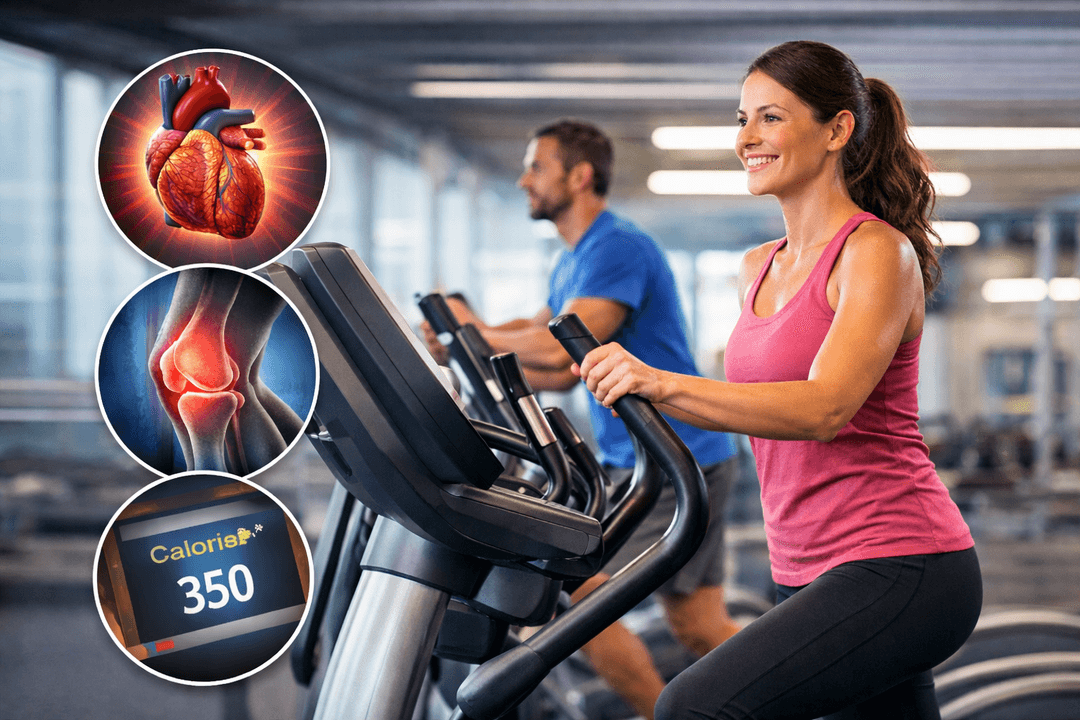
If you’ve ever seen people gliding on those machines with foot pedals and arm handles at the gym, you’ve witnessed an elliptical trainer in action. Elliptical machines (also called cross-trainers) are popular cardio workout devices found in both gyms and home setups. They simulate a motion that’s a mix between walking and stair climbing, but without the harsh impact of your feet hitting the ground. The result is a smooth, low-impact exercise that can elevate your heart rate, work muscles across your body, and torch calories all at once. No wonder the elliptical has become a go-to machine for millions of people looking for an efficient, full-body workout that’s gentle on the joints. Let’s break down exactly what an elliptical does for your body and why it might become your new favorite way to stay fit.
What is an elliptical machine?
An elliptical machine is a stationary exercise device with two large foot pedals and usually a set of handlebars. You stand upright on the pedals and move them in an oval or elliptical motion (hence the name), which creates a smooth gliding stride. At the same time, you can push and pull on the handlebars, engaging your upper body. In essence, an elliptical combines elements of running in place and climbing stairs, but with a fluid motion that feels more like “skiing” on air than pounding the pavement. Most modern ellipticals allow you to adjust resistance (and sometimes incline) to make your workout easier or harder. Some have stationary handlebars you can hold for balance, while others have moving arm handles to work your arms and shoulders as you stride.
In practical terms, using an elliptical is as simple as stepping on and starting to move. You can stride forward (as if walking or jogging) or even backwards to target your muscles a bit differently. Because you’re not lifting your feet and slamming them down, the movement feels low-impact and almost zero-gravity. Many people describe it as a gentler alternative to a treadmill. Yet gentle doesn’t mean ineffective; the elliptical provides an aerobic workout that can get your heart pumping and your legs working hard. In fact, it’s one of the most popular cardio machines for both gym enthusiasts and home exercisers because it delivers cardio + strength benefits in one shot. You don’t need separate machines for upper and lower body, the elliptical covers a lot of bases in a single, user-friendly workout.
Why ellipticals are considered low-impact exercise equipment
One of the biggest advantages of an elliptical is that it’s low-impact. In traditional cardio exercises like running or jumping, your feet leave the ground and come back down, which puts stress on your joints with each impact. On an elliptical, by contrast, your feet never leave the pedals. They move in a continuous elliptical path, so there’s no jarring impact at all. This design dramatically reduces the stress on your knees, ankles, and hips. Your joints appreciate this. It’s the same reason many doctors and physical therapists recommend ellipticals to people who find running painful or have conditions like arthritis.
Think of the elliptical motion as “gliding” rather than pounding. You get your heart rate up and muscles working without the wear-and-tear that a hard track or treadmill belt can inflict. Because of this, ellipticals are often described as joint-friendly machines. For example, health experts note that an elliptical provides a full workout that’s easy on the joints. If you have a history of knee pain or are carrying extra weight, an elliptical allows you to exercise vigorously while minimizing the risk of aggravating your knees or other joints. In short, you can go longer and more often because recovery is easier when you’re not constantly beating up your body with high-impact landings.
Don’t confuse low-impact with low-intensity, though. Just because the motion is smooth doesn’t mean you’re not working hard. An elliptical can be as challenging as you want it to be, you can increase the resistance level to make your legs push harder, or crank up your stride speed for a sweat-dripping cardio session. The key is that you’re in control of the intensity, and you’re doing it in a joint-safe way. This makes ellipticals especially appealing for those who want a tough workout without the joint soreness afterward. It’s exercise that’s gentle in feel but still delivers results.
How elliptical workouts improve cardiovascular endurance
Ellipticals are fantastic for your heart and lungs. As a cardio machine, the primary goal is to elevate your heart rate and keep it in a target zone that strengthens your cardiovascular system. When you hop on an elliptical and start moving, you’ll notice your breathing rate increase and your heart pumping faster, this means you’re challenging your cardiovascular endurance. Over time, regular elliptical workouts make your heart muscle stronger and your lung capacity larger. In fact, working at a moderate intensity on the elliptical can significantly improve your cardiorespiratory endurance, helping strengthen your heart and lungs.
The beauty of the elliptical is that you can tailor your cardio workout to your needs. Want to build endurance? You can do a steady 20-30 minute ride at a consistent pace, which trains your heart to be efficient over longer periods. Want to boost your stamina and aerobic capacity? You can incorporate high-intensity intervals, short bursts of very fast or high-resistance pedaling, which really challenge your heart and can lead to quick improvements in fitness. On an elliptical, it’s easy to alternate between high and low intensity (for example, 1 minute of hard effort followed by 1 minute of easy effort, repeated). This kind of interval training has been shown to improve cardiovascular fitness rapidly. Plus, it keeps the workout interesting.
Importantly, because ellipticals engage both upper and lower body, you’re recruiting a lot of muscles to help circulate blood and oxygen. This full-body engagement can make your heart work a bit harder (in a good way) to supply those muscles with oxygen. As a result, an elliptical session can give you a comparable cardio workout to other exercises like running or cycling. In fact, one study found that an elliptical can burn calories and raise heart rate on par with treadmill running, even if it feels slightly easier on your body. Over time, using the elliptical regularly can lead to lowered resting heart rate and improved endurance, you’ll notice daily activities (like climbing stairs or brisk walking) feel easier because your cardiovascular system is stronger. It’s all about consistency: aim for that recommended 150 minutes of moderate cardio per week (for example, 30 minutes five times a week), and the elliptical can get you there while keeping you entertained.
What does the elliptical work? (Muscles used)
One reason the elliptical is often praised as a full-body workout is that it engages multiple major muscle groups at once. Let’s start with the lower body: every stride on the elliptical works your legs and glutes. You’ll feel your quadriceps (front of the thighs) and hamstrings (back of thighs) doing much of the work to push and pull the pedals. Your gluteal muscles (buttocks) fire especially when you press down or if the machine has an incline feature, it’s similar to climbing a hill. Your calves also get in on the action at the lower part of the stride. Essentially, the entire lower body from your hips down to your heels is active on an elliptical, comparable to what you’d use during walking or running but with continuous resistance.
Now, add the upper body: if your machine has moving handlebars, you’re also pushing and pulling with your arms, chest, and back. Every time you drive the handles forward, you engage your chest and triceps; pulling back targets your upper back and biceps. It’s a bit like using ski poles on a cross-country ski machine, your arms contribute to the work. This means while your legs are propelling the pedals, your arms and shoulders are not just along for the ride; they’re helping out and toning up. Many ellipticals also have options to increase arm involvement (some classes or routines will have you let go with one arm or pump in certain ways to amplify the upper-body work).
Don’t forget your core muscles. Because you’re standing and moving, you naturally have to stabilize yourself. Your abdominal and lower back muscles contract to keep your posture upright and balanced, especially if you’re not leaning heavily on the handles. As a result, an elliptical session can engage your core more than, say, sitting on a stationary bike would. This improves your balance and works those deep stabilizer muscles. In fact, using an elliptical truly can recruit muscle groups from head to toe, from your deltoids and lats (in the shoulders/back) to your glutes, quads, and even down to your calves. The more muscles involved, the more calories you burn and the more comprehensive the workout. That said, you can also choose how much you use the arms: some people focus purely on legs by holding the stationary handles (for instance, if they want a lower-body isolation day), whereas others really pump the moving handles to get that upper-body toning.
In summary, an elliptical can strengthen and tone multiple muscle groups in one workout. You’ll build lower-body strength and endurance (think of stronger quads and glutes that help with everything from climbing stairs to squatting down to pick things up), and you’ll also give your upper body a bit of resistance training. It’s not the same as heavy weightlifting of course, but over time you may notice more definition in your arms and improved core stability. For a balanced fitness routine, an elliptical hits many birds with one stone, making it a time-efficient option for full-body conditioning.
Calorie burn, metabolic benefits, and fat loss
Many people hop on the elliptical with a goal of burning calories, and it certainly delivers on that front. Because the elliptical involves both the upper and lower body in continuous motion, it can expend a significant amount of energy. Exactly how many calories you burn depends on factors like your body weight, workout intensity, and duration. However, to give a rough idea: a half-hour moderate elliptical workout might burn roughly 270–400 calories on average. (Lighter individuals burn toward the lower end, heavier individuals toward the higher end, and adding more intensity bumps the number up.) Over an hour, it’s feasible to burn around 500–800 calories if you’re pushing yourself. This puts the elliptical on par with other vigorous activities like jogging. It’s an efficient way to help create the calorie deficit needed for weight loss, if that’s your aim.
Beyond the raw calorie count, elliptical training also has great metabolic benefits. Regular aerobic exercise, such as using the elliptical, can boost your metabolism over time. It trains your body to become more efficient at burning fat for fuel. Some research has even noted that consistent aerobic exercise is associated with reductions in abdominal fat, yes, that stubborn belly fat can shrink when you commit to regular cardio and a healthy diet. The elliptical can be a useful ally in this process because it’s something you can do frequently (remember, it’s low-impact so you can recover faster and potentially exercise more often). If you use an elliptical most days of the week, you’ll be upping your overall calorie burn and encouraging your body to tap into fat stores for energy.
One way to maximize fat loss on the elliptical is to incorporate high-intensity interval training (HIIT). This means alternating between periods of all-out effort and easier recovery. The elliptical is practically made for HIIT, since you can quickly adjust resistance or speed. For example, you might do 30 seconds of very fast pedaling at a challenging resistance, then 1 minute of slower, easy pedaling, and repeat that cycle for 15-20 minutes. These intervals send your heart rate soaring and can lead to an afterburn effect where your metabolism stays revved up even after you finish the workout. In other words, you’ll continue burning calories at an elevated rate for a while as your body recovers. HIIT on the elliptical is a win-win for calorie and fat burn, you hit both during the workout and in the recovery phase.
Of course, burning calories is just one part of the equation. The elliptical also helps improve your insulin sensitivity, circulation, and overall metabolic health by engaging large muscle groups regularly. It’s a heart-healthy exercise that can contribute to lowering blood pressure and improving cholesterol levels over time (as any consistent cardio regimen can). And since you can use the elliptical for long durations without excessive strain, it’s great for building endurance that enables you to burn even more calories in the long run. If weight loss or maintenance is your goal, pairing regular elliptical sessions with a sensible nutrition plan can be very effective. Even if you’re not focused on weight, the metabolic boost from an elliptical workout will leave you feeling energized and on a path to a healthier body composition.
The joint-friendly appeal: who benefits most
The elliptical’s low-impact nature makes it a lifesaver for people with joint concerns. If you have bad knees, achy hips, or are recovering from an injury, doing high-impact exercise can be painful or even risky. Ellipticals allow these individuals to get a solid workout without aggravating their condition. For example, someone with osteoarthritis in the knees might struggle with running but can likely use an elliptical comfortably, because it doesn’t slam the joints. In fact, experts often cite ellipticals as a great exercise option for those with knee pain or arthritis, since you get the benefits of walking/jogging without the pounding pressure on the joints.
Older adults often find ellipticals to be a gentle way to stay active. As we age, years of wear can make the joints less forgiving of impact. The elliptical provides a safe, controlled motion that can help seniors maintain cardiovascular fitness and leg strength without the risk of falls or impact injuries. Many rehab and physical therapy programs incorporate ellipticals as a stepping stone for getting people back to exercise after surgeries or joint replacements. For instance, after a knee surgery, once cleared by a doctor, a patient might start with short elliptical sessions to improve range of motion and blood flow to the area, rebuilding strength without over-stressing the healing joint. The elliptical’s smooth glide is perfect for easing back into activity.
Overweight individuals or beginners who are concerned about the stress of exercise on their body also benefit greatly from the elliptical. Carrying extra weight can make high-impact exercise more taxing on the knees and back. Ellipticals offer a way to get the heart rate up and burn calories without the sharp impacts, making it more comfortable to start moving. This can be incredibly encouraging for someone just starting their fitness journey, they can work up a sweat and feel their muscles working, but they’re not in pain from jolting movements. In fact, the machine fully supports your body weight as you exercise, which reduces strain while still letting you challenge yourself.
The joint-friendly appeal of the elliptical extends to almost anyone: folks with past sports injuries, those with chronic joint conditions, prenatal and postpartum moms who need gentler exercise, and even seasoned athletes on a recovery day. It provides a way to stay active even when high-impact isn’t on the menu. By keeping exercise accessible, ellipticals help people avoid skipping workouts due to pain. You can continue building fitness and strength in a safe manner. And as a bonus, because you’re not sidelined by joint pain, you’re more likely to stay consistent, which leads to better long-term results. In short, ellipticals empower people to keep moving when other forms of exercise might force them to stop.
Ellipticals as a stepping stone into consistent cardio
If you’re new to exercising or coming back after a long break, the elliptical can be the perfect stepping stone into a regular cardio routine. Why? First off, as we discussed, it’s easy on the body, so the intimidation factor is lower. Many beginners find the elliptical less daunting than trying to run or do high-impact classes right off the bat. You can adjust the settings to a comfortable level and simply get your legs moving. The learning curve is practically zero: just pedal and swing your arms in a natural rhythm. This simplicity means you can start getting the benefits of exercise from day one without worrying about complicated form or coordination. In fact, most users get the hang of the motion within a minute or two, even if they’ve never used an elliptical before. That immediate “I can do this!” feeling is a big confidence booster for someone just starting out.
Because ellipticals allow you to start slow and build up, they are excellent for developing consistency. In the beginning, you might do just 10 minutes at an easy pace, and that’s perfectly fine. You’ll still raise your heart rate and get your blood flowing. Over time, you can gradually increase your time to 15, 20, 30 minutes or more as your endurance improves. For instance, one beginner strategy is to add a couple of minutes each week. Start with 3 days a week of 10-minute sessions, then bump to 4 days or extend some sessions to 15 minutes, and so on. This gradual progression helps your body adapt without overwhelming you. Slow and steady wins the race. Experts often advise new elliptical users to ease in and focus on consistency rather than intensity at first. By doing so, you avoid burnout or injury and make exercise a habit.
The positive feedback loop with an elliptical is great for adherence: you’ll likely notice quick improvements in how long or how fast you can go. For example, after a couple of weeks, that 10 minutes that initially felt tiring might become your warm-up, and you’re ready to extend to 20 minutes. Seeing yourself progress is motivating and makes you want to continue. Additionally, because you can watch TV, listen to music, or even follow along with an on-screen class while on the elliptical, it can be a more engaging experience for beginners who might otherwise get bored with plain walking. Before you know it, 20 minutes are up and you’ve gotten a solid workout. The convenience of having an elliptical at home (if you do) also removes common barriers like “I don’t have time to go to the gym”, you can jump on for a few minutes here or there, which all adds up.
In short, the elliptical is friendly for all fitness levels, but it’s especially inviting for beginners. It offers a controlled environment where you can build cardio endurance without feeling like you’re “punishing” your body. Every age, shape, and size can step on and adjust the workout to their starting point. This approachability means you’re more likely to stick with it. And once you’ve built a base of regular cardio on the elliptical, you’ve opened the door to try all sorts of other activities with a stronger heart and more confidence. It truly is a gateway to a more active lifestyle, a stepping stone that can lead to running, cycling, or whatever you might want to explore down the road, or you can happily keep using the elliptical itself as your mainstay. Consistent cardio is what matters, and the elliptical makes consistency achievable.
Elliptical vs. treadmill or walking: key differences
Ellipticals are often compared to treadmills (or just regular walking/jogging) because all three are cardio staples. Each has its merits, but there are some key differences to consider:
- Impact: An elliptical is low-impact, your feet stay planted on the pedals, so there’s no pounding. Treadmills (and outdoor running) are high-impact; every step hits the belt or ground, which can stress joints but also helps maintain bone density. Walking is lower impact than running, but still involves repeated footfalls. If joint pain or injury is a concern, the elliptical clearly wins on gentleness.
- Muscles Used: A treadmill or walking primarily works your lower body: calves, quads, hamstrings, and glutes (especially if you add an incline or walk uphill). An elliptical works those too, plus your upper body and core if you use the arm handles. You’re basically getting a more complete muscle engagement on the elliptical. Treadmill users can incorporate arm movements or light weights, but it’s not built-in like with an elliptical.
- Calorie Burn: Both ellipticals and treadmills can burn a lot of calories. At equivalent effort levels, they’re pretty comparable in calorie expenditure. Some people might burn slightly more on a treadmill if they can run at a very vigorous pace, but many find they can push just as hard on the elliptical by increasing resistance and speed. One difference: treadmill running usually yields higher impact intensity, whereas elliptical allows a high heart rate with less perceived strain on joints.
- Workout Feel: Using an elliptical often feels easier on the body (because of the lack of impact), even if your heart rate is high. Treadmill running can feel tougher on your legs and can be mentally challenging for some due to the impact and monotony. Walking is easy on most people but may not get the heart rate up as much unless you walk very briskly or on an incline. Preference matters, if you love the sensation of running, a treadmill might appeal more; if you prefer a smoother motion, elliptical is the way.
- Versatility: Treadmills allow you to train for running events and to practice weight-bearing exercise (important for bone health) since you’re supporting your full weight with each step. Ellipticals, while weight-bearing (you stand on them), do reduce bone-loading compared to running. However, ellipticals shine in versatility of routines, you can do steady-state, intervals, pedal backward, go hands-free to test balance, etc. Both machines often have pre-programmed workouts (hills, intervals) to add variety. Walking is wonderfully accessible (you can do it anywhere), but it may lack the intensity or variety of the other two unless you incorporate different terrains.
In the end, whether an elliptical or treadmill is “better” depends on your personal needs and goals. If you’re prone to injury or want a full-body workout, an elliptical offers a low-impact, comprehensive solution. If you’re a runner training for races or want to maximize weight-bearing exercise, a treadmill (or outdoor running) might be more your style. And if you simply enjoy a good walk, that can be a fantastic, gentle exercise to keep you active for life. Some people even use both: ellipticals for cross-training on easy days and treadmills/running for high-intensity days. What’s great is that studies have shown the elliptical is just as effective at improving fitness as more impact-heavy exercise, so you’re not missing out on results by choosing the glide over the pound. It really comes down to what keeps you moving consistently. Both machines will improve your cardio, burn calories, and strengthen your legs; the elliptical just does it with a bit more comfort and multi-muscle engagement, while the treadmill/walking route gives you that classic simplicity of one foot in front of the other. There’s no one-size-fits-all, but it’s nice to have options!
At-home fitness: why ellipticals work in small spaces
For anyone setting up a home gym (even if it’s just a corner of your living room), an elliptical machine can be a smart choice for small spaces. Many ellipticals are designed with home use in mind, meaning they often have a smaller footprint than gym models or can be moved and stored conveniently. Some modern home ellipticals are even foldable or have wheels, so you can tuck them away when not in use. Even non-folding ellipticals generally only require an area about the size of a couch or less, and unlike a treadmill, you don’t need extra clearance for a big moving belt (just ensure you have enough ceiling height for your head when standing on it).
Another benefit in a home setting is that ellipticals tend to be quieter than treadmills. There’s no loud footfall noise or motor whine from a spinning belt. The motion is smooth and most of the sound comes from the flywheel and pulley system, which on a well-made machine is a gentle whir. This is great news if you live in an apartment or have family members/roommates, you can do a late-night or early-morning workout on an elliptical with minimal disturbance. Being quiet also means you can easily listen to music, watch TV, or take an online class without cranking the volume to drown out your exercise machine.
From a functionality standpoint, an elliptical in a small space gives you a lot of bang for your buck. It combines the role of multiple machines, you can use it for cardio, some strength (due to resistance levels), and full-body engagement, so you don’t need separate devices like a bike, a treadmill, and a rowing machine unless you want those options. If you’re limited on space, having one machine that can deliver a variety of workouts is ideal. You can do a light recovery session one day, a hardcore interval blast the next, all on the same piece of equipment. Many ellipticals also come with built-in workout programs and even streaming capabilities or device holders so you can follow along with guided routines (like Fitscope’s) on your tablet or screen. Essentially, you can turn a small area of your home into a versatile cardio zone.
Placement-wise, ellipticals are pretty forgiving. You don’t necessarily need a dedicated gym room. A lot of people keep an elliptical in the bedroom or living room and hop on while watching their favorite show. Because the movement is stable (you’re not jumping around), you can safely have it on any hard floor surface; just put a mat under it to protect the floor and catch sweat. It doesn’t generate the heavy vibrations a treadmill might. And unlike some bulky gym equipment, an elliptical machine can look relatively sleek, many have modern designs that don’t scream “gym equipment” when not in use. All in all, for home fitness, an elliptical strikes a great balance: compact, quiet, and multi-purpose. It enables you to get a full, effective workout in the comfort of your home, even if space is limited. That convenience can be a game-changer for keeping up with your fitness routine.
Structured elliptical workouts: why guidance matters
Stepping onto an elliptical and moving is easy, but having a structured workout to follow can make a world of difference in your results. It’s the difference between mindlessly gliding for 20 minutes while staring at the wall versus engaging in a purposeful session that challenges you and keeps you motivated. Guided elliptical workouts (whether via a class, a trainer, or an app) provide structure in the form of intervals, resistance changes, and technique cues. This structure is important because it ensures you’re continually progressing and not plateauing. It’s easy to fall into a comfortable routine on any cardio machine, doing the same thing every time. While any movement is good, doing identical workouts over and over can lead to stagnation, your body adapts and you stop seeing improvements. A structured plan will mix it up: for example, pushing you to go a little faster or harder in certain intervals, or try new patterns like pedaling backwards or letting go of the handles to test balance.
Another big reason guidance matters is motivation and engagement. Let’s face it, doing the exact same elliptical workout daily can get boring for your mind, even if your body is working. Boredom is the enemy of consistency. A coached or planned workout introduces variety and often fun elements (like music or themes) to keep you mentally in the game. You might find yourself actually looking forward to an interval segment or a sprint at the end, simply because it’s something different and challenging. Structured workouts are usually crafted by fitness professionals to maximize effectiveness, they know how to warm you up properly, challenge you in the middle, and cool you down safely. This means you get more out of the 30 minutes you spend than if you just pedaled at one steady pace. In fact, alternating between steady state and interval sessions throughout the week can yield better cardio improvements than only doing one or the other. Variety truly helps.
Guidance also helps with proper form and technique. A good instructor will remind you to keep your shoulders relaxed, stand tall, engage your core, and not to hunch over, all those little cues that make your workout more effective and safe. They might prompt you to actively use the arms (“don’t just let the handles drift, really push and pull!”) or to focus on your glutes during an incline segment (“sit back into your heels as you climb this hill”). These cues turn a mediocre workout into a great one by ensuring you’re targeting the right muscles and not cheating yourself by slacking on resistance. They also reduce the risk of you developing bad habits (like leaning too much on the machine, which can lessen your results or strain your back). Essentially, having a plan or person to follow takes the guesswork out of exercise. You can just listen and respond, which often means you’ll push harder than you would on your own. For instance, you might think you’re at your limit after 5 minutes, but an upbeat coach can talk you through another minute at that resistance, and boom, you’ve broken through a barrier.
Finally, structured workouts often incorporate goal-setting and progress tracking. They might say, “Today we’re doing a 20-minute endurance ride; remember your distance because next time we’ll try to beat it.” This gives you a tangible target and a sense of accomplishment when you hit it. Over time, following a program can significantly boost your fitness because it systematically increases the challenge as you improve. Contrast that with doing random elliptical sessions, you might maintain general fitness, but you’re less likely to continually improve. By all means, hopping on for an easy-going session while you watch TV has its place (recovery days, etc.), but combining those with some guided, structured workouts is the recipe for real progress. You’ll get the most out of your elliptical, stay engaged, and see steady improvements in your endurance, strength, and calorie burn. It’s like having a roadmap to your fitness goals instead of wandering aimlessly. Who wouldn’t want that?
How Fitscope’s classes enhance results
One of the best ways to experience structured elliptical workouts is through Fitscope’s on-demand classes, which are specifically designed to enhance your results and keep you coming back for more. Fitscope Studio offers a wide variety of guided elliptical sessions led by enthusiastic, upbeat instructors (think of them as your personal coaches on-screen). These classes take all the benefits of elliptical training and crank them up a notch with music, motivation, and smart programming. Rather than doing a mundane “same old” workout, you can choose from sessions like a Rhythm Elliptical ride (where you pedal to the beat of energizing music) or an interval blast, or even a hybrid Elliptical Bootcamp that mixes floor exercises with cardio. This variety means you’ll never get bored, one day you might be grooving to 80s pop while climbing imaginary hills, another day you’re doing a beginner-friendly steady ride, and another you’re tackling a HIIT sprint session. Keeping workouts fresh is a big factor in staying consistent, and Fitscope excels at that by offering every type of class from short beginner-friendly options to intense advanced challenges.
Guidance and motivation are where Fitscope classes truly shine. The instructors don’t just tell you what to do, they encourage you every step of the way, just like a friendly coach at the gym. They’ll cue you to increase resistance (“Let’s turn it up a notch for 30 seconds, you got this!”) or ease off when it’s time to recover, ensuring you hit the right intensity at the right time. They also provide form tips throughout, reminding you to keep that good posture and engage your core, which helps you get more out of each movement. Many users find that they push themselves harder and achieve higher intensity levels in these classes than they would alone. It’s a lot easier to handle a tough interval when a coach is cheering in your ear and a killer playlist is driving you forward. And speaking of music, Fitscope’s Rhythm Elliptical classes are a game-changer for making cardio fun. By syncing your strides with upbeat songs, you almost forget you’re exercising. Time flies when you’re effectively dancing on the elliptical, and by the end you’ve torched calories with a smile on your face.
Another advantage of Fitscope’s platform is the on-demand flexibility. You aren’t tied to a gym schedule, you can press play on a class anytime that suits you, morning, lunch break, or midnight if that’s when you’re free. This flexibility is huge for consistency. When it’s easy to fit a workout into your day, you’re far more likely to stick with a routine. Fitscope classes are available 24/7, so your elliptical can be in motion whenever you are ready. Plus, the classes range in length from quick 10-15 minute blasts to full 40+ minute endurance rides, so even on busy days you can squeeze in a shorter session and still feel accomplished. This level of convenience and choice removes a lot of the common excuses (“I don’t have time,” “I missed the class time,” etc.), helping you stay on track. It’s no surprise that people who embrace at-home platforms like this often work out more consistently than gym-goers, it just fits better into real life.
Fitscope also leverages technology and metrics to enhance your results. If your elliptical is compatible, you can see live stats like your cadence (RPM), resistance level, heart rate, and so on, on the screen during classes. This data-guided approach lets you know exactly how hard you’re working and encourages you to gradually push a bit more. For example, you might notice you’re cruising at 60 RPM and the instructor challenges you to hit 65 RPM in the next sprint, having that number visible can motivate you to go for it. Tracking these metrics over time also shows your progress: maybe last month you used resistance level 3 for intervals and now you’re comfortably doing level 5. Seeing improvement is extremely motivating and keeps you engaged. It makes sense, watching yourself get better is addictive (in a good way). Fitscope’s classes tap into that by providing feedback and even celebrating milestones (like “You’ve completed 5 classes this week!” or hitting a personal best distance in a session).
Finally, Fitscope’s vibe is friendly and inclusive. The tone is always encouraging, coaches offer modifications if you’re a beginner (so you never feel left behind) and extra challenges if you’re more advanced. It feels like working out with a positive community, even though you’re physically on your own. They’ve got programs and series tailored to different goals too (for instance, a beginner elliptical series that gradually ramps up, or themed challenges). And if you need an extra push, you can set goals within the app or follow one of their multi-week training plans. All these features mean you’re not just using an elliptical, you’re effectively getting a personal trainer and a cheering squad in your living room. The result? Better workouts and better results. Plus, it’s just more fun, and when exercise is fun, it becomes something you want to do, not have to do. Fitscope even offers a free trial period, so it’s easy to test out a few classes on your elliptical and see how they elevate your exercise experience. Don’t be surprised if you find yourself pedaling to the beat and wondering where the last 30 minutes went!
Elliptical cardio that supports your whole body
The elliptical machine is truly a full-body cardio hero. It checks so many boxes: boosting your heart health and endurance, strengthening and toning muscles throughout your body, burning a substantial number of calories, and doing it all with minimal impact and stress on your joints. It’s a form of cardio that meets you where you are, whether you’re a total beginner easing into exercise, an athlete looking for cross-training, or somewhere in between. By incorporating the elliptical into your routine, you’re investing in a workout that is efficient and effective while also being kind to your body. You can go hard on it when you want a challenge, or take it easy on recovery days, knowing that you’re still benefiting your heart, lungs, and muscles without grinding your joints. Over time, consistent elliptical workouts can lead to a stronger, leaner body and improvements in things like balance and posture (thanks to that core engagement). It’s fair to say this machine supports your whole body, both literally as you stand on it and figuratively in the fitness gains it provides.
What makes elliptical training even more exciting today is how accessible and engaging it can be. With the rise of on-demand platforms like Fitscope Studio, you have a wealth of resources to keep your elliptical sessions fresh and fun. Instead of viewing exercise as a chore, you might find yourself genuinely enjoying those 20-30 minutes of “me time” on the pedals, dancing along to a rhythm ride or feeling accomplished after conquering a tough interval class. By taking advantage of guided classes and the flexibility of at-home workouts, you remove many barriers that often derail fitness efforts. No traffic to the gym, no strict class times to juggle, just hop on and go. And as you’ve seen, this convenience tends to translate into greater consistency, which is the secret sauce of any successful fitness journey. Little by little, those consistent workouts add up to big changes: improved stamina, weight loss or management, toned muscles, and a boost in confidence knowing you’re taking care of your health.
So, what does an elliptical machine do for your body? In a nutshell: it strengthens your heart, works your muscles from head to toe, burns off calories to help with fat loss, and safeguards your joints in the process. It’s a workout that welcomes all ages and fitness levels, and it grows with you as you get fitter. If you’re looking for a reliable way to get fit or stay fit, the elliptical is a fantastic tool. Pair it with some motivating music or a Fitscope class, and you’ve got the energy of a studio session with the comfort of home. Lace up your sneakers, grab a water bottle, and step onto those pedals, your whole body will thank you. Fitness is a journey, and an elliptical might just be the smooth ride that keeps you moving forward toward your goals, one stride at a time. Now, ready to press “Start” and enjoy an awesome workout? Your body is ready when you are!

Commercial Subscription
Allows Fitscope classes to be used in a commercial gym or boutique studio (1 location) with up to 500 members. Multiple simultaneous users enabled. Lets Talk!

© Fitscope Technologies LLC, 2023
Powered by  Fitcaster