
Fitscope Studio
March 12, 2026, 1 min
How Large Brands Outsource Part of Production Without Losing Control
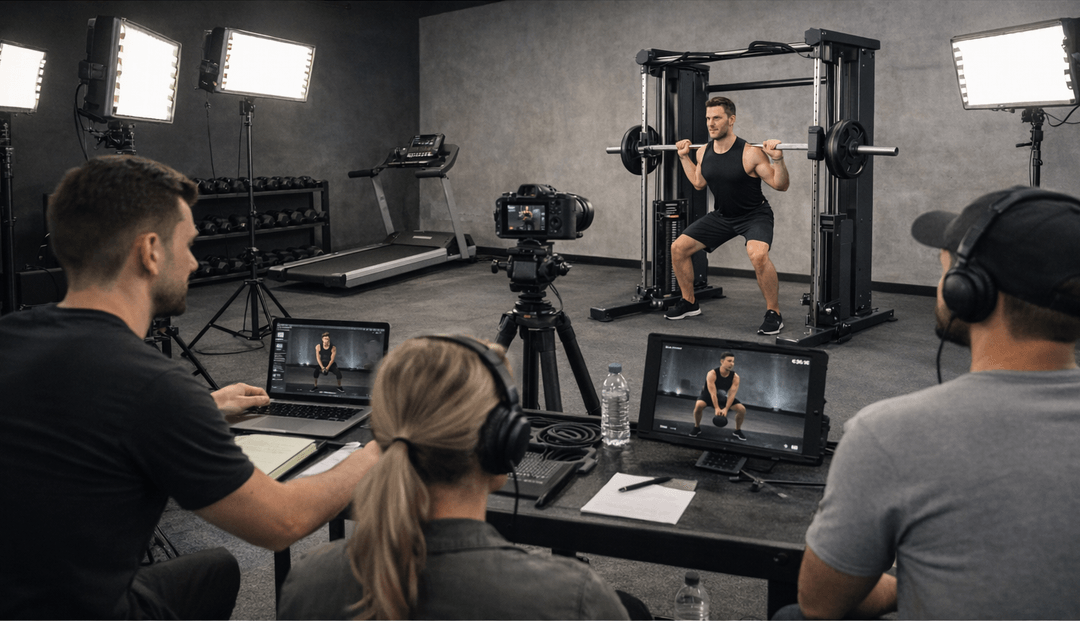
Most fitness equipment brands that have built a content library understand the same uncomfortable truth: the demand for fresh, high-quality workout content grows faster than any internal team can sustainably produce it. Class libraries need regular refreshes. New equipment launches require dedicated content from day one. Seasonal programming, instructor variety, and expanding modality coverage all increase the volume of production work, and at a certain scale, keeping everything in-house becomes a bottleneck rather than a competitive advantage.
Outsourcing solves the capacity problem. But for brands that have invested years in building a specific visual identity, coaching standard, and production quality, handing production to an external partner raises a legitimate concern: how do you scale output without diluting what makes your content recognizable? The answer is not choosing between control and efficiency. It is building the systems that let you have both. This article walks through exactly how established fitness brands outsource a portion of their production workflow while maintaining a consistent look, feel, and standard across every piece of content that reaches their platform.
Partial Outsourcing vs. Full Outsourcing: Choosing the Right Model
The first decision is not whether to outsource, but how much. Full outsourcing transfers the entire production pipeline to an external studio, from program design through final delivery. This model works for brands entering connected fitness for the first time or launching a new content vertical without existing infrastructure. Partial outsourcing is more common among brands that already have a mature production operation and need to augment capacity without replacing their internal team.
In a partial outsourcing arrangement, the brand retains ownership of certain high-control functions while delegating others to a production partner. Typically, the brand keeps creative direction, program architecture, and final approval authority. The external partner handles execution: studio time, camera operation, lighting, audio capture, and often post-production. Some brands also outsource instructor casting and talent management to a partner with an established network in a specific market.
The advantage of partial outsourcing is that it preserves the brand's editorial control over what gets made while relieving pressure on the operational side of how it gets made. The challenge is that it requires clear documentation of standards, a disciplined alignment process, and a review workflow that catches inconsistencies before content reaches the platform. The rest of this article focuses on building those systems.
What Must Be Standardized Before the First Frame Is Shot
Outsourced fitness production fails when the brand assumes the partner will intuitively match its look and feel. They will not. Visual and audio standards that feel obvious to an internal team are invisible to an external partner unless they are explicitly documented. Before any filming begins, the brand needs to define and share standards across five production dimensions.
Lighting is the most visible element of production consistency. A class filmed under cool, diffused overhead panels will look and feel entirely different from one shot with warm side lighting and dramatic shadows. The brand should provide a lighting diagram or reference images from existing content that define the baseline: color temperature, key light placement, fill ratios, and any practical lights visible in frame. If the external studio uses different equipment, a test shoot should confirm that the output matches the reference before a full production block begins.
Camera angles and shot selection define how the user experiences the class. A cycling class might rely on three angles: front hero, side profile, and a close-up of the console or cadence display. A strength class might need an overhead angle for floor work and a wide shot for standing movements. The brand should provide a camera map for each class format specifying the number of cameras, their positions relative to the set, lens focal lengths, and the switching cadence between shots. If the internal team cuts between angles every eight to twelve seconds, the external partner should match that rhythm.
Graphics and lower thirds include any on-screen elements that appear during the class: exercise name overlays, timer countdowns, instructor name badges, resistance indicators, and branded intro and outro sequences. These assets should be delivered to the partner as templated files with clear placement specifications, font standards, and animation timings. If the brand uses motion graphics, the partner needs access to the source files and rendering specifications, not just a reference video.
Audio standards cover instructor voice levels, music bed volume, the ratio between the two, and any sound design elements like transition cues or countdown tones. The brand should provide a reference mix and specify target levels in LUFS for both the voice track and the final master. Music licensing is another area that requires explicit alignment. The brand should confirm whether the partner is sourcing music independently, drawing from a shared licensed catalog, or using tracks selected by the brand's creative team.
Color grading and post-production style tie everything together visually. A warm, slightly desaturated grade communicates a different brand personality than a high-contrast, vivid treatment. The brand should provide a LUT or grading reference that the partner's colorist can apply consistently. If the brand has a specific editing pace, transition style, or text animation standard, those should be documented as well.
Replicating a Set in an External Facility
When a brand outsources to a studio in a different city or country, the physical set becomes the most tangible expression of brand identity. If the set does not match, the content will feel disconnected from the rest of the library regardless of how well every other standard is met.
Set replication begins with precise documentation of the existing environment. This means dimensional drawings of the studio floor plan, including equipment placement, instructor mark positions, and camera positions relative to the set walls. It includes material and finish specifications for flooring, wall treatments, and any built set pieces like shelving, accent panels, or branded signage. Paint colors should be specified by manufacturer code, not by visual approximation. Flooring should match in both material and color, because even a slight difference in reflectivity or texture will be visible on camera.
The brand should also provide a reference photo set: wide shots from each camera position, detail shots of key set elements, and images showing how the set looks under production lighting versus ambient room light. These references give the partner's set designer a visual target alongside the dimensional specs. A video walkthrough of the original set, narrated by the production lead, is even more effective because it communicates the spatial relationships and sightlines that flat photos can miss.
Once the replicated set is built, a validation shoot should be conducted before any content goes into production. Film a single class or a set of test sequences and compare the output side by side with content from the original studio. Review for lighting match, color consistency, framing alignment, and audio characteristics. Adjust before committing to a full production schedule. This single step prevents the most common and most costly outsourcing failure: producing an entire block of content that does not visually integrate with the existing library.
The Pre-Production Alignment Checklist
Every production block with an external partner should begin with a formal alignment process. This is not a casual kickoff call. It is a structured review that confirms both parties are working from the same specifications before resources are committed.
The alignment checklist should cover the production schedule, including shoot dates, class counts per day, and buffer time for technical issues or reshoots. It should confirm the class list with formats, durations, difficulty levels, and instructor assignments. Equipment requirements should be verified, including the specific machines, accessories, and props that need to be on set and functional. Wardrobe guidelines for each instructor should be confirmed, including approved colors, logos, and any items that are prohibited. The music plan for each class should be locked, with licensing confirmed and track lists provided to the audio engineer. And the review workflow should be agreed upon in advance, including who reviews dailies, how feedback is delivered, how many revision rounds are included, and what the final approval process looks like.
This checklist is not bureaucracy. It is the mechanism that prevents misalignment from compounding across a multi-day production block. A single missed detail on day one, such as an instructor wearing an unapproved color or a camera angle that drifts from the spec, can affect dozens of classes if it is not caught early.
The Remote Review Workflow
When production happens in one location and the brand team sits in another, the review workflow becomes the primary quality control mechanism. It needs to be fast, structured, and unambiguous.
The most effective approach uses a three-stage review process. The first stage is dailies review: at the end of each shoot day, the production partner uploads raw or lightly edited selects from the day's filming. The brand's creative lead reviews these within 24 hours to confirm that lighting, framing, instructor performance, and audio quality meet standards. Any issues flagged at this stage can be corrected on the next shoot day while the set is still built and the crew is still on site. This is by far the most cost-effective moment to catch problems.
The second stage is rough cut review: once post-production begins, the partner delivers rough cuts of each class with temporary graphics, color grading applied, and audio mixed to near-final levels. The brand reviews for pacing, cueing accuracy, editorial flow, and any content-level issues such as incorrect exercise names, unsafe form that was not caught on set, or music mismatches. Feedback should be delivered in a standardized format with timecodes and specific instructions rather than general impressions.
The third stage is final approval: the partner delivers the finished class with all graphics, grading, audio mastering, and metadata applied. The brand conducts a final quality check against the delivery specifications and either approves the file for platform upload or returns it with specific technical notes. At this stage, revisions should be limited to technical corrections, not creative changes. If the workflow is functioning properly, creative issues are resolved during the first two stages.
A shared project management platform, whether that is Frame.io, Wipster, or even a structured shared drive with clear folder conventions, keeps the review process organized and auditable. Every piece of feedback should be documented, and every approval should be recorded. This protects both the brand and the partner when questions arise later.
Instructor and Wardrobe Standards for Consistency
Instructor presentation is where brand consistency is most easily disrupted and most difficult to fix in post-production. An instructor who cues differently than the rest of the roster, wears clothing that clashes with the set palette, or brings a coaching energy that does not match the brand's tone will produce content that feels out of place, no matter how well the technical production matches.
The brand should provide the production partner with a documented instructor brief that covers cueing style and vocabulary standards, including specific terms the brand uses and terms it avoids. It should specify wardrobe guidelines in detail: approved color families, fabric types that read well on camera, logo placement rules, and any items that conflict with the brand's visual identity. If the brand provides wardrobe, the logistics of sizing, shipping, and backup options should be confirmed before the shoot.
For brands outsourcing instructor casting to the production partner, the casting criteria should be equally specific. Technical certification requirements, on-camera audition expectations, cueing style examples, and the ability to deliver modifications and progressions within a single class are all elements that should be defined upfront. The brand should review and approve audition tapes before any instructor is confirmed for a production block. Casting alignment is easier to get right at this stage than to correct after filming.
File Delivery Specifications and Naming Conventions
The final handoff is where many outsourcing relationships introduce unnecessary friction. If the brand and partner are not aligned on file formats, resolution, codec, audio channel configuration, and naming conventions, every delivery requires manual reformatting before the content can be ingested into the platform. Over dozens or hundreds of files, this adds up to significant time and cost.
The brand should provide a written delivery specification that covers video format and codec, frame rate, resolution, audio channel layout, loudness targets, and file container. It should also include a naming convention that encodes the metadata the platform needs for ingestion: class format, instructor name, difficulty level, duration, and production date. A consistent naming structure such as [Format]_[InstructorLastName]_[Level]_[Duration]_[Date] eliminates ambiguity and makes batch processing possible.
Thumbnail and promotional image specifications should be included as well, covering resolution, aspect ratio, safe zones for text overlays, and any brand-mandated composition rules. If the brand requires closed captions or subtitle files, the format and delivery timeline should be specified. These details are not glamorous, but they are the difference between a delivery that flows directly into the publishing pipeline and one that creates a backlog.
Starting With a Pilot Shoot
The most effective way to validate an outsourcing partnership before committing to a full production calendar is to begin with a pilot. A pilot shoot is a small-scale production block, typically two to five classes, that tests every element of the workflow: set match, lighting calibration, instructor performance, audio quality, review cadence, and delivery specifications.
The pilot should be treated with the same rigor as a full production block. It should follow the complete alignment checklist, use the documented standards, and go through the full review workflow. The purpose is not to produce content quickly but to identify gaps between the brand's expectations and the partner's execution before those gaps multiply across a larger volume of work.
After the pilot, both teams should conduct a structured debrief. What matched the standard? What deviated? Where did the workflow create friction? What needs to change before the next block? This debrief should produce a revised set of working documents that both parties sign off on before the first full production block begins. Brands that skip the pilot in the interest of speed almost always lose more time correcting issues at scale than they would have spent validating the partnership upfront.
Governance: Who Owns Decisions and Timelines
The final layer of a successful outsourcing arrangement is clear governance. Governance defines who has decision-making authority at each stage of the production process, how disputes are resolved, and what the escalation path looks like when something goes wrong.
At minimum, the governance structure should designate a single point of contact on each side. The brand's production lead owns creative approval, schedule changes, and final sign-off. The partner's production manager owns execution, crew coordination, and daily logistics. These two people communicate directly and frequently, and neither is required to route decisions through layers of management that slow the process down.
Timelines should be documented with specific milestones: pre-production alignment deadline, shoot dates, dailies delivery windows, rough cut delivery dates, feedback turnaround commitments, final delivery dates, and platform publish dates. Each milestone should have an owner and a consequence for missing it. This is not about creating an adversarial relationship. It is about making expectations explicit so that both teams can plan their resources with confidence.
Content ownership and usage rights should be defined in the partnership agreement before any filming begins. The brand should confirm whether it owns the raw footage, the finished masters, or both, and whether the partner retains any usage rights for portfolio or promotional purposes. Music licensing rights, instructor likeness releases, and geographic distribution permissions should all be addressed. These are standard contractual items, but they are frequently overlooked in the urgency to start filming, and resolving them retroactively is always more expensive and complicated than handling them upfront.
Scaling Production Without Scaling Risk
Outsourcing fitness production is not about finding a vendor. It is about building an extension of your production operation that can execute at your standard, on your timeline, without requiring your team to be in the room for every frame. The brands that do this well share a common trait: they invest in documentation, alignment, and governance before they invest in studio time. They treat the relationship as a system, not a transaction.
The reward is significant. A well-structured outsourcing partnership lets a brand increase content volume, expand into new modalities, refresh its library on a consistent cadence, and respond to new equipment launches with ready-to-publish content without scaling headcount or building additional studio infrastructure. It turns production capacity from a fixed constraint into a flexible resource.
The brands that approach this strategically will build libraries that grow with their hardware and keep their subscribers engaged long after the initial purchase. The brands that approach it casually will spend more time fixing inconsistencies than they saved by outsourcing in the first place.
About Fitscope
Fitscope is an LA-based connected fitness production studio that produces trainer-led, equipment-based content across more modalities than nearly anyone in the industry. We work with equipment brands, OEMs, and platform operators as both a content licensing partner and a full-service production house, managing the pipeline from program design and instructor casting through filming, post-production, quality assurance, and delivery. Our team understands both the creative and operational sides of fitness content production, which is why brands trust us to produce at their standard without requiring their team on set for every shoot.
If you are looking for a production partner who can extend your content operation without compromising your brand, we would welcome the conversation.

Commercial Subscription
Allows Fitscope classes to be used in a commercial gym or boutique studio (1 location) with up to 500 members. Multiple simultaneous users enabled. Lets Talk!
© Fitscope Technologies LLC, 2023
Powered by  Fitcaster