
Fitscope Studio
February 18, 2026, 1 min
Turn Your Equipment Into a Subscription Business with Coaching Content
The One-Time Sale Problem
Equipment brands have a margin problem, and it starts the moment a product ships. Hardware carries development costs, manufacturing overhead, logistics, and retail markdowns — all compressed into a single transaction. Once the buyer takes delivery, the revenue relationship ends. There is no second invoice. No monthly touchpoint. No reason for the customer to open your app or visit your site again.
Meanwhile, the brands gaining market share are the ones that have figured out what happens after the sale. They pair machines with coaching content, convert buyers into subscribers, and build a recurring revenue layer that compounds over time. The model is not theoretical. Connected fitness brands are already using data and smart equipment to drive engagement, reduce churn, and create long-term customer relationships that outlast any single product cycle.
This article breaks down how equipment manufacturers can make that shift — from one-time hardware sales to a subscription business powered by coaching content. It covers the content strategy, the retention mechanics, the metrics that matter, and a 90-day starter plan to get moving.
Why Coaching Content Is a Business Asset, Not a Feature
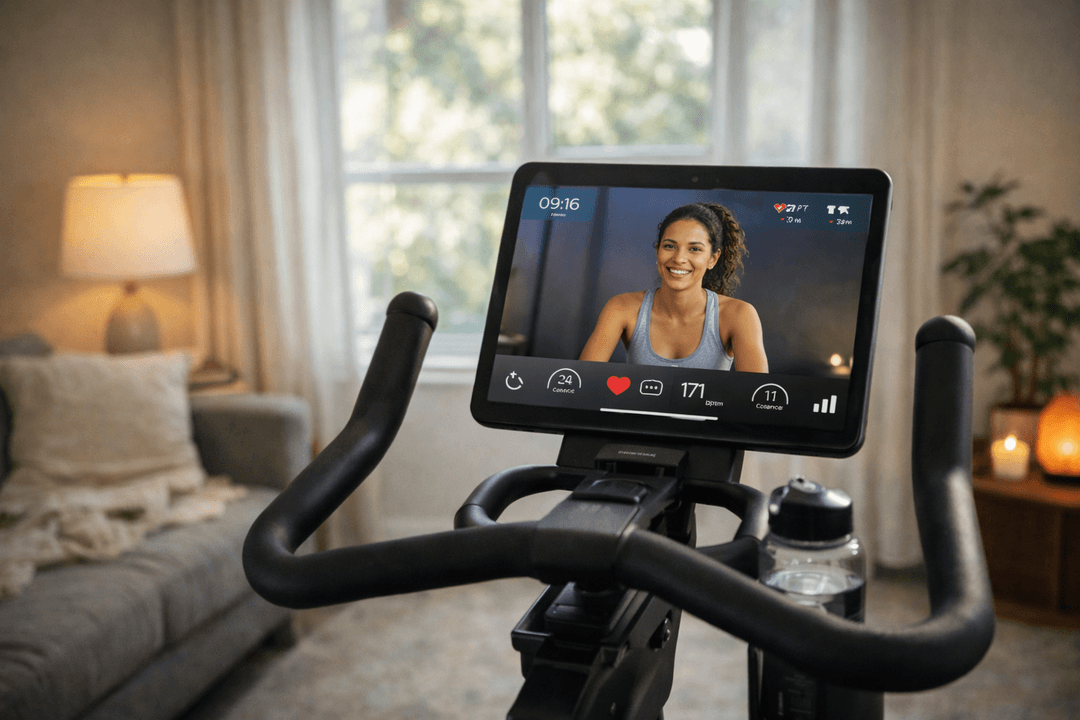
Content is easy to dismiss as a marketing expense. But in the context of connected fitness, coaching content is the product that generates recurring revenue. The equipment opens the door. The content keeps the customer paying.
Consider the economics. A treadmill or rower sells once. A monthly content subscription attached to that machine generates revenue for months or years after the initial purchase. Over a two- to three-year ownership cycle, subscription income can match or exceed the margin on the hardware itself. That changes the financial profile of the entire business — from lumpy, seasonal hardware revenue to a predictable, compounding subscription base.
Coaching content also solves one of the oldest problems in home fitness: abandonment. Most home equipment goes unused within a few months of purchase. Structured programming — led by real trainers, designed around specific equipment, and built with progression in mind — gives the buyer a reason to show up. When they show up, they stay subscribed. When they stay subscribed, lifetime customer value increases and support costs decrease.
For OEM leaders evaluating where to invest, the question is no longer whether to offer content. It is how fast you can build a content engine that supports retention at scale.
Mapping Content to the Subscriber Lifecycle
A library of random classes does not build a subscription business. What builds a subscription business is content that maps directly to the stages of the customer lifecycle — from activation through long-term retention. Each stage has a different job, and the content has to be designed accordingly.
Activation: The First Seven Days
The moment a buyer unboxes equipment and opens the companion app is the highest-leverage window in the entire relationship. If they complete a workout in the first session, the probability of a second session rises significantly. If seven days pass without a workout, reactivation becomes expensive and unreliable.
Activation content should be short, welcoming, and equipment-specific. Think 10- to 15-minute introductory classes that walk the user through basic movements, console features, and what to expect from a full session. The goal is not to impress them with intensity. The goal is to reduce friction and build a habit before the subscription trial ends.
Onboarding: Weeks Two Through Four
Once a user has completed a few sessions, structured programs take over. A beginner cycling program, a couch-to-5K treadmill plan, or a rowing fundamentals series gives the subscriber a clear path. Programs create commitment. A user halfway through a four-week plan is far less likely to cancel than a user browsing a library with no direction.
Onboarding content should introduce variety gradually. If the equipment supports it, this is also the stage to layer in connected fitness features — Bluetooth pairing, heart rate tracking, and real-time metrics — so the user experiences the full value of the platform early.
Retention: Month Two and Beyond
Retention content is where depth matters. Challenges, progressive overload plans, seasonal themes, and new instructor series give long-term subscribers something to look forward to. Without fresh content, engagement decays. With it, the subscriber develops a routine around the platform, and cancellation becomes a disruption to their schedule rather than an easy decision.
Retention-stage content should also expand beyond the primary equipment type. A rower owner might appreciate a core stability series. A treadmill user might value a recovery and mobility program. Cross-category content increases time on platform, deepens engagement, and makes the subscription feel more valuable than any single class.
In-App Hooks That Drive Weekly Sessions
Great content gets people started. Behavioral mechanics keep them coming back. The most effective subscription apps use a combination of lightweight engagement tools that reinforce consistency without feeling gimmicky.
Streaks are one of the simplest and most effective. A visible counter that tracks consecutive workout days (or weeks) creates a small psychological cost to skipping a session. Milestones — 10 rides completed, 50 kilometers rowed, 100 workouts logged — give subscribers a sense of progress that sits alongside their physical results.
Progressive overload plans take this further. Rather than leaving the user to self-select difficulty, the app can recommend the next class based on their recent output. If a cyclist averaged 150 watts last week, the platform nudges them toward a session targeting 155 to 160 watts. This kind of data-guided programming turns a passive library into an active coaching relationship — and it is one of the strongest retention signals in connected fitness.
Push notifications and email sequences also play a role, especially around content drops. When a new program launches or a challenge opens, a well-timed notification can pull a lapsed user back into a session. The key is relevance. Generic reminders feel like spam. Equipment-specific, behavior-triggered messages feel like coaching.
A Six-Month Content Calendar for Equipment Brands
Launching a content subscription without a roadmap leads to the most common failure mode in the space: too few classes, released too slowly, with no narrative arc. A six-month calendar provides structure and ensures the library grows with purpose.
Month One: Foundation
Publish introductory classes for each supported equipment type. Cover basic form, console orientation, and first-workout sessions. Launch one beginner program per equipment category (four to six sessions each). This is the content that activates new subscribers.
Month Two: Progression
Add intermediate-level programs that build on the foundation content. Introduce interval-based formats — HIIT cycling, tempo runs, power rows — that appeal to users who have moved past the beginner stage. Begin publishing classes that reference performance metrics so users engage with their data.
Month Three: Variety
Expand into complementary modalities. Strength training, core work, recovery, and mobility sessions extend the platform beyond cardio equipment and increase per-session value. This is also a strong month to introduce a multi-week challenge that spans equipment types.
Month Four: Community
Launch a live event or time-limited challenge that creates shared experience among subscribers. Leaderboards, group milestones, and instructor-led live sessions introduce social accountability. Even modest community features can meaningfully reshape engagement and retention patterns in subscription fitness.
Month Five: Depth
Publish advanced programs for experienced users who have been on the platform since launch. Add specialty content — endurance blocks, sprint series, sport-specific training — that rewards long-term subscribers with programming they cannot easily find elsewhere.
Month Six: Refresh and Expand
Retire underperforming introductory content and replace it with updated versions. Introduce new instructors or formats to signal that the library is evolving. Use six months of engagement data to identify which content types drive the highest session frequency and double down.
Content by Equipment Type: What Works
Not all equipment supports the same content strategy. The programming, pacing, and coaching style should reflect how people actually use each machine.
Treadmills support the widest range of content formats — walking, power walking, running, incline intervals, and bootcamp-style sessions that alternate between the belt and the floor. Treadmill subscribers tend to prefer shorter, high-intensity sessions during the week and longer endurance classes on weekends. A strong treadmill library includes both.
Rowers are well suited to structured interval training and technique-focused coaching. Because rowing form has a steeper learning curve, tutorial content performs especially well in the first month. Progressive programs that build from 15-minute sessions to 40-minute endurance rows keep users engaged as their fitness improves.
Indoor bikes are the most proven format in connected fitness. Cycling content benefits from rhythm-based programming, music-driven energy, and visible metrics like cadence and output. A deep cycling library should span beginner rides, advanced climbs, HIIT sprints, and low-impact recovery sessions to serve the full subscriber base.
Ellipticals and other low-impact machines are underserved in the market, which creates a differentiation opportunity for brands willing to invest. Users on these machines often include older adults, individuals managing joint concerns, and prenatal populations — all of whom benefit from coaching that emphasizes form, pacing, and modification. Brands that offer classes across these modalities tend to see broader subscriber demographics and lower churn in those segments.
Pricing and Bundle Positioning
Pricing a content subscription is less about finding the perfect number and more about framing the value relative to the hardware purchase. The most effective positioning ties the subscription to the equipment experience rather than presenting it as a separate expense.
Bundling works. Including a free trial period (typically 30 to 90 days) with every equipment purchase gives the buyer time to build a habit before a payment decision arrives. The longer the trial, the higher the conversion rate — but only if the content is strong enough to justify the transition from free to paid.
Tiered pricing can also support different user segments. A basic tier might offer access to the on-demand library, while a premium tier includes live classes, personalized recommendations, and advanced performance tracking. The goal is to create a natural upgrade path rather than a single take-it-or-leave-it offer.
Avoid discounting the subscription aggressively at launch. Low introductory pricing can attract trial users who never intended to pay full price, which inflates early subscriber counts but creates a churn spike at the first renewal. Price for the user who values coaching, not the one shopping for a deal.
Metrics That Matter
Subscription content businesses live and die by a small set of leading indicators. Track these from day one.
Activation rate measures the percentage of new equipment buyers who complete at least one workout within the first week. If this number is low, the onboarding content or app experience needs attention before anything else.
Weekly active sessions is the clearest signal of content-market fit. Subscribers who average two or more sessions per week have dramatically lower churn than those averaging one or fewer. Content strategy should be oriented around moving more users above that threshold.
30-day retention shows how many trial users convert to paying subscribers. This metric reflects whether the content delivered enough value during the free period to justify a recurring charge. Benchmark against industry norms, but focus primarily on your own trend line month over month.
Content completion rate indicates whether classes are the right length, difficulty, and format for the audience. A high drop-off rate at the 10-minute mark of a 30-minute class is a content problem, not a user problem.
Churn rate is the trailing indicator that confirms whether everything upstream is working. Monthly churn above five to seven percent in a consumer subscription signals structural issues — either the content is stale, the onboarding is weak, or the value proposition is unclear.
Common Failure Modes
Most equipment brands that attempt a content subscription and struggle share a few predictable patterns.
The first is launching with too few classes. A library of 20 or 30 sessions might look sufficient on paper, but a subscriber who works out three times per week will exhaust that library in two months. At that point, the content feels repetitive and the subscription feels overpriced. Plan for library depth from the start, and commit to a publishing cadence that stays ahead of your most active users.
The second is building a library with no progression. A flat collection of standalone classes gives users no reason to follow a sequence, complete a program, or track improvement. Without progression, there is no narrative. Without narrative, there is no stickiness.
The third is underinvesting in coaching quality. Production value matters, but instructor presence matters more. Users subscribe for the coaching relationship — the trainer who remembers to cue recovery, who explains why an interval matters, who makes a 20-minute session feel purposeful. Generic, low-energy instruction is the fastest way to lose subscribers regardless of how the video looks.
The fourth is treating content as a marketing expense rather than a product line. Subscription content needs its own roadmap, its own quality assurance process, and its own performance metrics. Brands that bury content under the marketing department tend to understaff, underfund, and ultimately underdeliver.
Your First 90 Days Post-Launch
For OEM teams ready to move, here is a practical framework for the first 90 days of a coaching content subscription.
Days 1 through 30: Launch with a minimum viable library — introductory classes for every supported equipment type, one beginner program per category, and a small selection of standalone sessions across beginner and intermediate levels. Activate new buyers with an in-box insert, a setup email sequence, and a prominent app prompt that drives them to their first class. Measure activation rate daily.
Days 31 through 60: Publish intermediate programs and expand class variety. Introduce at least one cross-category format (strength, core, or recovery) to broaden the value proposition. Launch a push notification sequence for users who completed onboarding content but have not started a second program. Review weekly active session data and identify where users disengage.
Days 61 through 90: Open a time-limited challenge or community event to create shared momentum among early subscribers. Publish the first batch of advanced content for high-frequency users. Analyze 30-day retention and content completion rates to inform the next quarter's production roadmap. Begin planning the Month Four through Six content calendar based on real usage data rather than assumptions.
By the end of 90 days, you should have a functioning content engine, a growing subscriber base with measurable habits, and enough data to make confident decisions about where to invest next.

Building the Engine
The shift from hardware sales to subscription revenue is not a pivot. It is a layer — one that compounds on top of every machine sold. The equipment remains the entry point. Coaching content becomes the ongoing relationship. And the subscription becomes the financial model that funds continued investment in both.
Brands that build this engine early will own the customer relationship long after the sale. Those that wait will compete for attention against platforms that already have libraries, instructors, and retention systems in place.
The infrastructure to support this — from production services and content licensing to white-label platform delivery — already exists. The question is not whether the model works. It is whether your team is ready to build it.

Commercial Subscription
Allows Fitscope classes to be used in a commercial gym or boutique studio (1 location) with up to 500 members. Multiple simultaneous users enabled. Lets Talk!

© Fitscope Technologies LLC, 2023
Powered by  Fitcaster