
Fitscope Studio
November 18, 2026, 1 min
Exercise Classes Inside Senior Living Technology: What Platform and Product Teams Need to Know
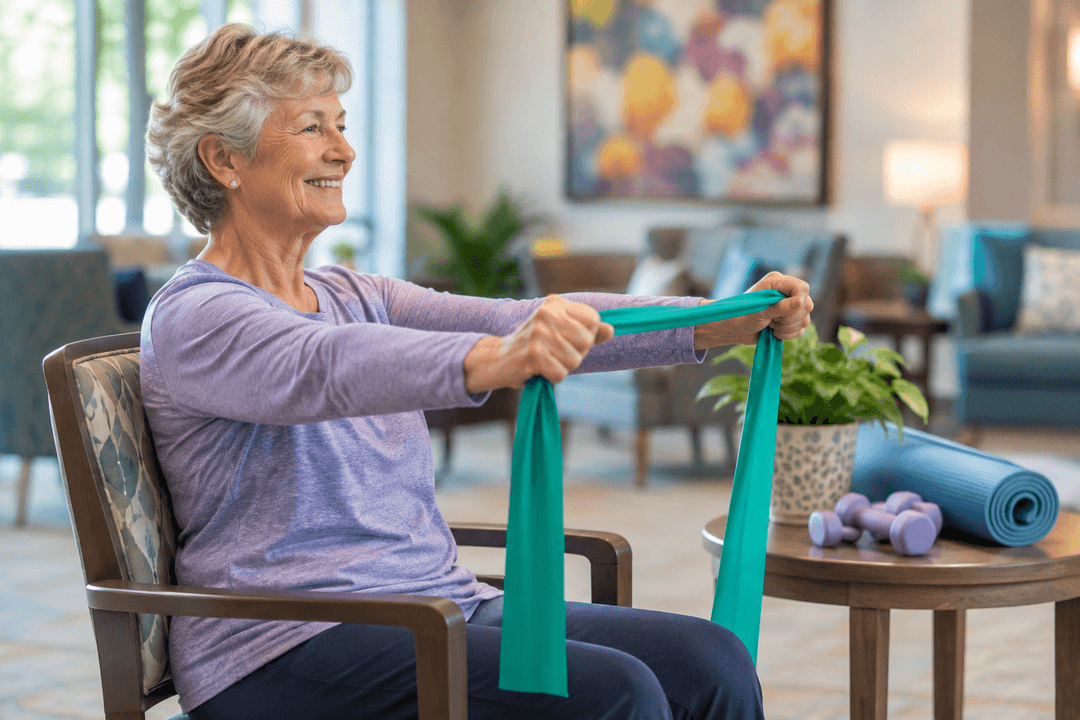
Senior living technology platforms add exercise classes by licensing a ready library or commissioning custom filming, and what the footage shows on screen decides which. Four checks visible in the footage settle it: setup shown, cue pace, a seated alternative, and captions. We also cover how licensed classes plug in, the tags staff schedule by, and the variables that scope a deal.
This is a partner-to-partner guide for product, content, and partnerships leads at resident engagement platforms, senior living activity software companies, and senior wellness apps that build senior living technology for resident engagement. It assumes you already run the activity calendar, the family portal, and the in-room channels, and that exercise is the piece you are deciding how to source. Activity directors evaluating a vendor can forward the section on the three users of a class on its own.
Most resident engagement platforms still leave exercise outside the product
Most resident engagement platforms still leave exercise outside the product, and that gap sits directly on top of the adoption problem operators report most often. In Argentum's technology adoption research, 61% of respondents named adoption and consistent use of technology by staff and residents as a top-three issue, and 77% ranked interoperability as a top-three implementation issue.
A typical senior living software stack already carries the activity calendar, music, games, family messaging, and in-room TV channels. Exercise usually lives somewhere else. It is a DVD in the activity closet, a link to a third-party site, or a staff-led stretch session with no digital footprint, so it never appears in the platform's participation data. Communities want one place for activities, and the "one platform" pitch most vendors make often has a hole shaped like exercise. A class library with no scheduling hook leaves that hole open and becomes one more link residents never open.
A scheduled class inside the platform can help with adoption because it gives activity staff a recurring, calendar-driven reason to open the product several times a week. The roadmap decision is whether exercise enters as content you license, content you commission, or both.
One class reaches three users: the activity director, the resident, and the family
One 25-minute exercise class inside a senior living platform reaches three users in a single day, and each of them meets it on a different screen. Follow that class from morning to evening.
At 10:00, an activity director opens the lounge TV for twelve residents. Some will sit for the whole class, a few will stand behind their chairs, and one arrives late with a walker. She needs to find the class in two taps, start it without hunting through menus, and pause it when someone needs a minute to settle. If the start screen confuses her in front of that room, the experiment usually ends there. The director's lounge TV is where a class library gets adopted or abandoned, and most guides design for the resident and forget her.
At 3:00, a resident in assisted living opens the same class on an in-room tablet with no staff present. Exercise content for assisted living tablets has to work for her alone, which means a large and obvious start button, captions on by default, and an instructor who shows the setup before each movement.
At 8:00 that evening, her daughter checks the family portal and sees two classes attended this week. She sees participation. She never sees the footage or any health interpretation.
For your product team, the lesson is that each user needs a different surface and different metadata. The director needs filters and playback control, the resident needs a simple player with captions, and the family needs a participation record. Classes placed on the calendar staff already use can also help reduce one-off setup, because the session is booked in advance instead of improvised that morning. Decide which of the three surfaces your first release supports.
Senior-ready is a production standard you can check on screen
Senior-ready is a production standard defined by four features you can verify by watching a class, and three of the four are decided on set.
Is setup shown before each movement? The instructor positions the chair, shows foot placement or grip, and only then begins. That sequence is written in program design and captured at filming, and no edit can add a setup shot that was never recorded. Decided at filming.
Is the cueing slow enough to follow without staff? Cue pace and the lead time before each transition are locked on the day of filming. An editor can trim a pause but cannot slow a rushed cue into a usable one, and a resident following alone has nobody to repeat it. Decided at filming.
Is a seated or supported alternative demonstrated on camera? A second performer, or the instructor, models the chair-based or supported version alongside the standing one so a mixed room can follow the same class. That takes casting and blocking in program design, plus camera positions that keep both versions in frame for the full class. Decided at filming.
Are captions available? Captions can be produced in post from the finished audio. They are the one item a platform can retrofit onto existing footage. Added later.
In an end-to-end production, setup shots and seated alternatives are planned in program design, the second performer is chosen in casting, and cue pace is set during filming. Captions and on-screen labels arrive in editing and motion graphics, ahead of QA and delivery. Coaching lines such as "All levels welcome" and "Start where you are" signal intent, yet they cannot stand in for the on-screen features. A class built this way is designed for all levels and can be modified.
"Senior-friendly" on a library listing tells you very little, and a platform that licenses footage hoping to fix it in post usually ends up paying twice. Before your next content call, watch three classes you are considering with the sound off and ask the four questions.
Four ways licensed classes plug into senior living technology
Licensed exercise classes plug into senior living technology in four ways: embedded video, a white-label library, file delivery, and API delivery. In every case, the classes publish inside your own app, web experience, or in-community screens, so residents and staff never leave the platform to work out. Embedded video is the fastest path, with licensed classes playing inside your existing interface. A white-label library places the catalog under your brand and navigation, which is how most white label exercise content for senior care software reaches residents. File delivery sends video files and metadata to your specification for your own player and CDN. API delivery lets your platform pull the catalog and its tags programmatically, so new classes appear automatically. For a platform with a small release team, file delivery with clean metadata often goes live faster and breaks less often than an API integration.
Licensed classes drive use only once the platform's scheduling features can place them on the activity calendar, assign them to a room or a screen, and surface them in each resident's view. Scheduling is the step that ties content to the calendar activity staff already rely on. Streaming also depends on each community's network, so bandwidth in the lounge and in resident rooms belongs on the discovery checklist.
Where an independent-living fitness room has connected cardio, Bluetooth FTMS (a wireless standard that lets fitness equipment share live metrics such as speed, cadence, and heart rate with an app) can display real-time metrics when supported, and compatibility varies by device. Agree in the contract how resident and usage data is handled under your platform's own privacy policy. We evaluate equipment and integration paths during discovery, so the decision now is which delivery path your engineers will actually maintain.
Tag every class by intensity, position, equipment, and length before it reaches a calendar
Every exercise class should be tagged by intensity, position, equipment, and length before it reaches a senior living activity calendar, because activity directors schedule by fit instead of by title. An untagged library forces staff to preview each class before they can book it, and the working tag set looks like this.
- Intensity level tells staff how demanding a class is, so they can balance a week and avoid placing the two hardest sessions on the same morning.
- Seated or standing position is the filter activity directors reach for most often, because it decides whether a class works for a mixed-ability lounge group.
- Equipment needed (none, a chair, a resistance band, or a cardio machine) tells staff exactly what to set out before residents arrive in the room.
- Length lets a class fit a programmed slot between lunch, a music session, and an afternoon outing without running into the next activity.
- Captions available flags classes that work for residents with hearing loss and for lounges where conversation or a nearby TV competes with the audio.
- Setup shown marks classes in which the instructor demonstrates positioning first, so they can run on a resident's tablet with no staff demonstration beforehand.
Tagging also gives a platform something it can count. Argentum found that just 26% of respondents reported a clear, shared understanding of how to define and measure resident health and wellness outcomes. Consistent tags will not settle that question, but they give operators one practical starting point the platform controls, because participation can be reported by intensity, position, and length. Two hundred untagged classes typically serve an activity director worse than sixty tagged ones with a real seated-to-standing mix. Agree the tag schema with your content partner before the first delivery.
License the library for fitness rooms, film the chair-based program your clinicians design
The license-or-produce decision for a senior living platform usually splits by resident population. Take a platform serving a campus with two wings. Independent living has a fitness room with treadmills, bikes, and a rower. The assisted-living wing has a therapy team that wants a chair-based program residents can follow from their rooms, and those two wings call for different sources.
A licensed library is the faster path for active residents and fitness rooms
Licensing exercise classes for a senior living platform makes sense where the residents and the equipment match an existing catalog. Our fitness video licensing library is equipment-based, covering walking and running, cycling, rowing, treadmill, elliptical, and strength and recovery formats, with upbeat, inclusive coaching that welcomes beginners while still challenging experienced users. For an independent-living fitness room, licensing reduces time-to-market and production overhead compared with building a studio and filming hundreds of videos from scratch. Run the four on-screen checks against any class you shortlist, including ours.
A clinician-designed program needs its own filming
A chair-based program for assisted living or memory care belongs to your clinicians, and it needs its own filming. Your clinicians or the community's therapy team design the program and own its content. We manage fitness video production end-to-end, covering casting, filming to the four on-screen checks, captions, QA, and delivery in your platform's format with your tags already applied. You maintain brand control throughout. We will also tell you plainly when our existing library is the wrong answer for a population.
Most campuses end up with a hybrid that licenses for the fitness room and produces the chair-based core. Spending production budget where footage genuinely cannot be retrofitted is the right call, while spending it to recreate walking and cycling classes that already exist rarely is. Before scoping either, map each resident population on your platform to a source.
Shared lounge screens need commercial terms, not a consumer subscription
Shared lounge screens need commercial terms, because a class streamed to a community lounge TV or common-area display is commercial use. A consumer subscription playing on a lounge screen is not a licensing model, and terms vary by use case. The most common mistake in this category has little to do with price. It is the assumption that a stream on a lounge TV is the same as one resident watching on a personal device. An exercise content deal for senior living software is scoped by four variables: the number of communities, the number of residents, the number of screens or surfaces where classes play, and the term length. The library mix and the release cadence follow from those variables and are set in the agreement. Quotes and detailed terms come from our team, and you can review our senior living and active aging solutions before requesting one. Count your communities, residents, and screens before the first call. Getting the surface count right up front prevents a renegotiation six months in.
Suitability belongs to your platform and each care team, not the content studio
Suitability for any exercise class belongs to your platform and each community's care team, and the published evidence on older adults and online classes speaks to use and perception. In a study of adults 60 and over, real-time virtual exercise classes were the most common remote exercise support (used by 44%), and 92% rated live online classes moderately or very effective for helping them stay active at home. That rating is the respondents' own view of staying active, and it is not a health measure.
Regular exercise can support strength and cardiovascular fitness over time, and our content claims go no further. Fitscope provides general fitness content. Your platform decides where classes appear and how they are labeled. Each community's care team decides which residents participate and with what modifications, and for custom programs, your clinicians design the program. The content makes no prevention, treatment, or rehabilitation claims, and a studio that tells you its classes are suitable for your residents is overstepping. Write the suitability language into your platform's class pages and your contract before launch, so staff and families read the same scope.
Questions senior care software teams ask before adding exercise classes
These are the questions product and partnerships leads raise most often when exercise content enters a senior care technology roadmap.
What are some helpful technologies for seniors?
Video calling, voice assistants, in-room TV, tablets, and resident engagement platforms make up the common senior care technology stack. Exercise video fits best as a module inside the engagement platform, where residents already find their calendar and messages.
What are some examples of assistive technology for older people?
Typical categories include hearing support, magnification and large-display tools, mobility aids, and medication reminders. Exercise content carries accessibility features of its own, since captions, seated alternatives, and on-screen setup are built into the class itself.
What are some examples of technology used in patient care?
Patient-care technology in senior living includes electronic health records, eMAR, nurse call systems, and remote monitoring. Exercise classes are engagement content that sits alongside those systems and makes no clinical claims.
What are some effective marketing ideas for senior living?
A full activity calendar with visible class participation gives a community something concrete to show families on a tour. Your platform can help by surfacing that participation in a family-facing view or a tour-ready calendar screen.
How many classes should a platform launch with?
Plan the launch around mix, enough to fill a typical week, rather than around a target class count. That means seated and standing options across intensities and lengths, so repeats do not become obvious to residents who attend daily.
How often do new classes arrive?
Release cadence is agreed in the licensing or production agreement and scaled to the term. Our team sets the specifics with you during scoping.
Can the classes carry our platform's branding?
Yes, white-label delivery places the library under your own interface and navigation. Custom production can also carry your brand on camera and in motion graphics.
About Fitscope, the studio behind your platform's exercise module
Fitscope is a connected-fitness content studio and technology platform built around equipment-based workouts. We license trainer-led classes across walking, cycling, rowing, treadmill, elliptical, and strength and recovery formats, and we produce custom programs end-to-end for partners whose clinicians have designed them, delivered into your platform with your tags applied. We produce content across a wide range of equipment modalities, and we will say so plainly when the footage you already have is good enough.
The first conversation is the on-screen test. Bring the classes or the program brief you are considering, and we will evaluate them against the four checks and your integration path during discovery, then scope the work by communities, residents, screens, and term. Talk to our team when you are ready to compare options.
Fitscope provides general fitness content for educational and entertainment purposes and does not provide medical, legal, or professional advice. Always consult a qualified professional before beginning a new exercise program. Results vary and workouts should be modified to your ability and comfort level.

Commercial Subscription
Allows Fitscope classes to be used in a commercial gym or boutique studio (1 location) with up to 500 members. Multiple simultaneous users enabled. Lets Talk!

© Fitscope Technologies LLC, 2023
Powered by  Fitcaster